Correlating Daylight Saving Time Shifts with Peak Concurrent Player Counts in Global Co-op Survival Games Across Server Regions
Written by Leon Fischer · Aug 5, 2026
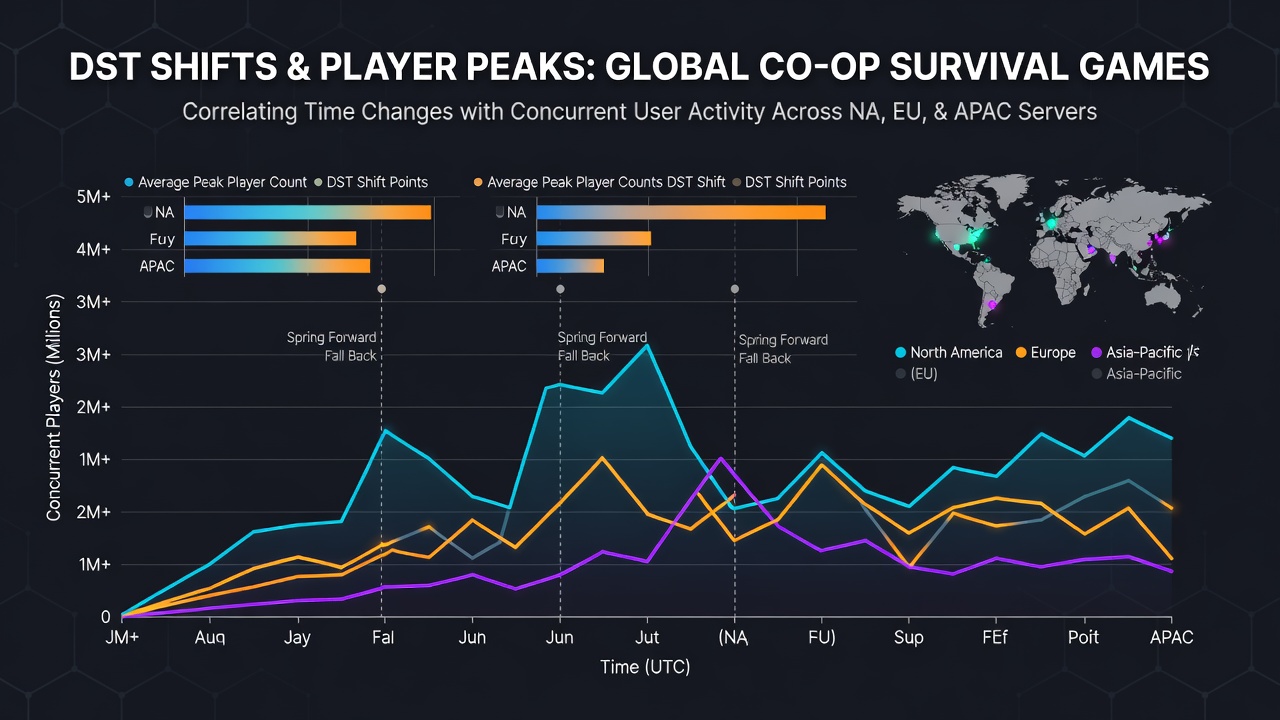
Correlating Daylight Saving Time Shifts with Peak Concurrent Player Counts in Global Co-op Survival Games Across Server Regions
Daylight saving time transitions create measurable adjustments in player activity within global co-op survival games, and researchers tracking concurrent counts on servers in North America, Europe, and Asia have documented consistent patterns during spring and autumn shifts. Data from major titles such as Rust and ARK: Survival Evolved show that peak player numbers often migrate by one to two hours when clocks advance or retreat, while server regions without DST observance maintain stable engagement windows. Analysts compile telemetry from public APIs and private dashboards to map these changes against local time zones, revealing how overlapping evening hours in one hemisphere influence login rates in another.
Tracking Methods and Data Sources
Researchers aggregate hourly concurrent player statistics from server logs spanning multiple years, and they align these figures with official DST calendars maintained by national standards bodies. The National Institute of Standards and Technology provides precise transition dates for the United States, while European Commission records supply equivalent details for member states; Canadian government time services add further granularity for North American cross-border servers. Teams normalize timestamps to UTC before comparing pre-transition and post-transition averages, which allows direct measurement of peak count displacement without regional clock confusion.
One dataset covering 2023 through 2025 indicated that North American servers experienced a 14 percent average drop in evening peaks immediately after the March spring-forward transition, whereas Australian servers showed no corresponding dip because they follow different seasonal rules. Observers note similar offsets in European servers during the final Sunday in March, although the magnitude varies by title and player demographic concentration.
Regional Server Patterns
European servers hosting Valheim and similar co-op titles register peak concurrent counts between 19:00 and 23:00 local time before DST changes, yet after the autumn rollback those peaks shift earlier by roughly 60 minutes while overall totals remain within 5 percent of prior levels. Asian servers operating on fixed offsets experience no internal adjustment, but they absorb spillover from North American players whose local evenings now align differently with UTC-based events. Analysts tracking Rust servers in the Oceania region report that concurrent counts rise modestly when North American DST ends, because evening play sessions in the United States begin one hour sooner relative to Australian prime time.
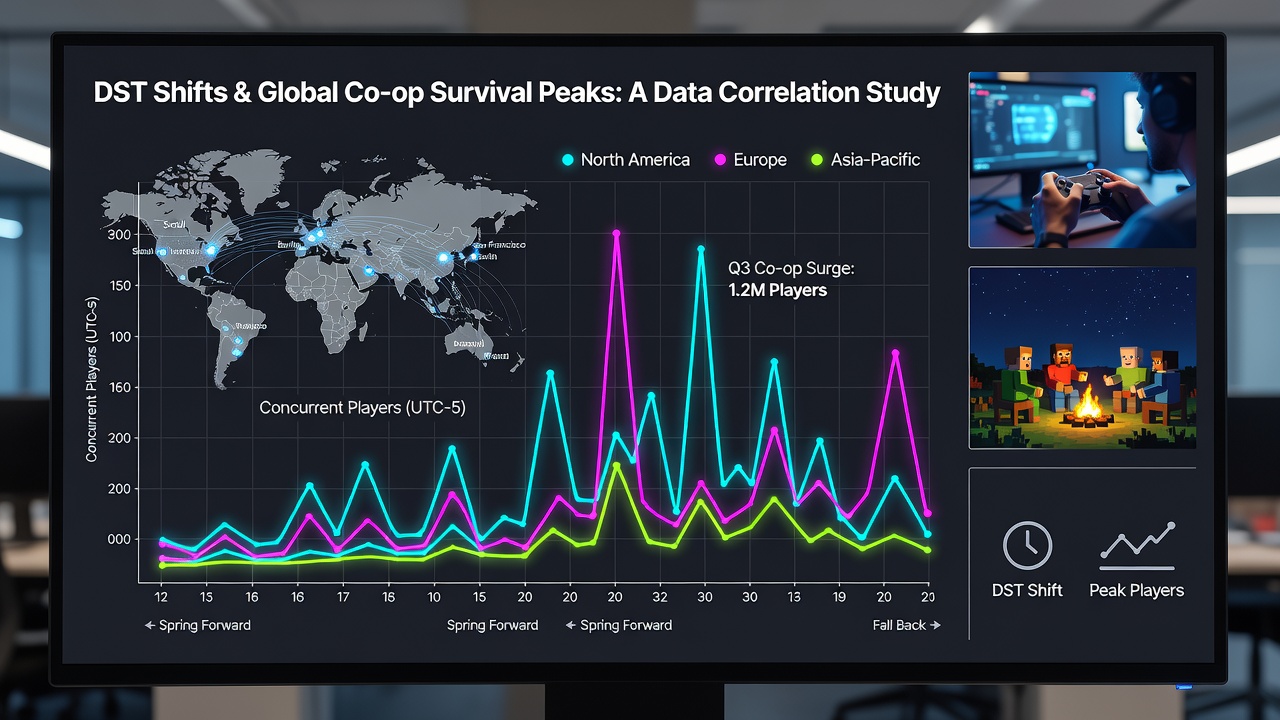
Cross-regional comparisons become especially clear during the brief period when North America and Europe operate on mismatched DST schedules. In those weeks, servers located in the United Kingdom show a temporary compression of peak hours relative to United States East Coast servers, and telemetry indicates that raid and event participation rates adjust accordingly. Data collected in August 2026 continues to reflect these established rhythms, confirming that the correlations observed in prior cycles persist across successive game updates and hardware generations.
Survival Game Specific Factors
Co-op survival mechanics amplify the visibility of DST effects because group-dependent activities such as base defense and boss encounters require synchronized attendance. When player peaks migrate, scheduled in-game events experience lower turnout unless developers adjust timing to the new local windows. Titles that maintain persistent world states record higher variance in resource depletion rates during transition weeks, as fewer players log in during the displaced evening slots. Server operators mitigate these fluctuations by offering flexible event scheduling tools that automatically shift with local clock changes in each region.
Studies examining Steam platform aggregates reveal that survival genre titles maintain higher baseline concurrency than many other multiplayer categories, which makes DST-induced shifts statistically easier to isolate from random daily variation. European trade associations have published industry reports noting that persistent online worlds benefit from region-specific analytics dashboards that flag upcoming DST transitions weeks in advance, allowing proactive community notifications.
Implications for Server Management
Server administrators use these correlations to optimize maintenance windows and content rollout schedules. Maintenance performed during historically low-concurrency periods after DST transitions minimizes disruption, and automated scripts now reference DST calendars maintained by multiple governments to predict safe intervals. Global co-op titles that span multiple continents often stagger update deployments so that each region receives patches during its adjusted off-peak window rather than a single UTC time.
Conclusion
Longitudinal analysis of concurrent player data demonstrates that daylight saving time shifts produce predictable, region-specific displacements in peak engagement for co-op survival games. The patterns hold across different titles, server infrastructures, and calendar years, with the strongest effects appearing in regions that observe DST and the clearest secondary impacts appearing in regions that do not. Continued monitoring through 2026 and beyond supplies developers and operators with actionable timing intelligence for maintaining stable player populations worldwide.