30 May 2026
Investigating Achievement Unlock Rate Patterns as Predictors of Sustained Engagement Levels in Expansive Action Role-Playing Titles
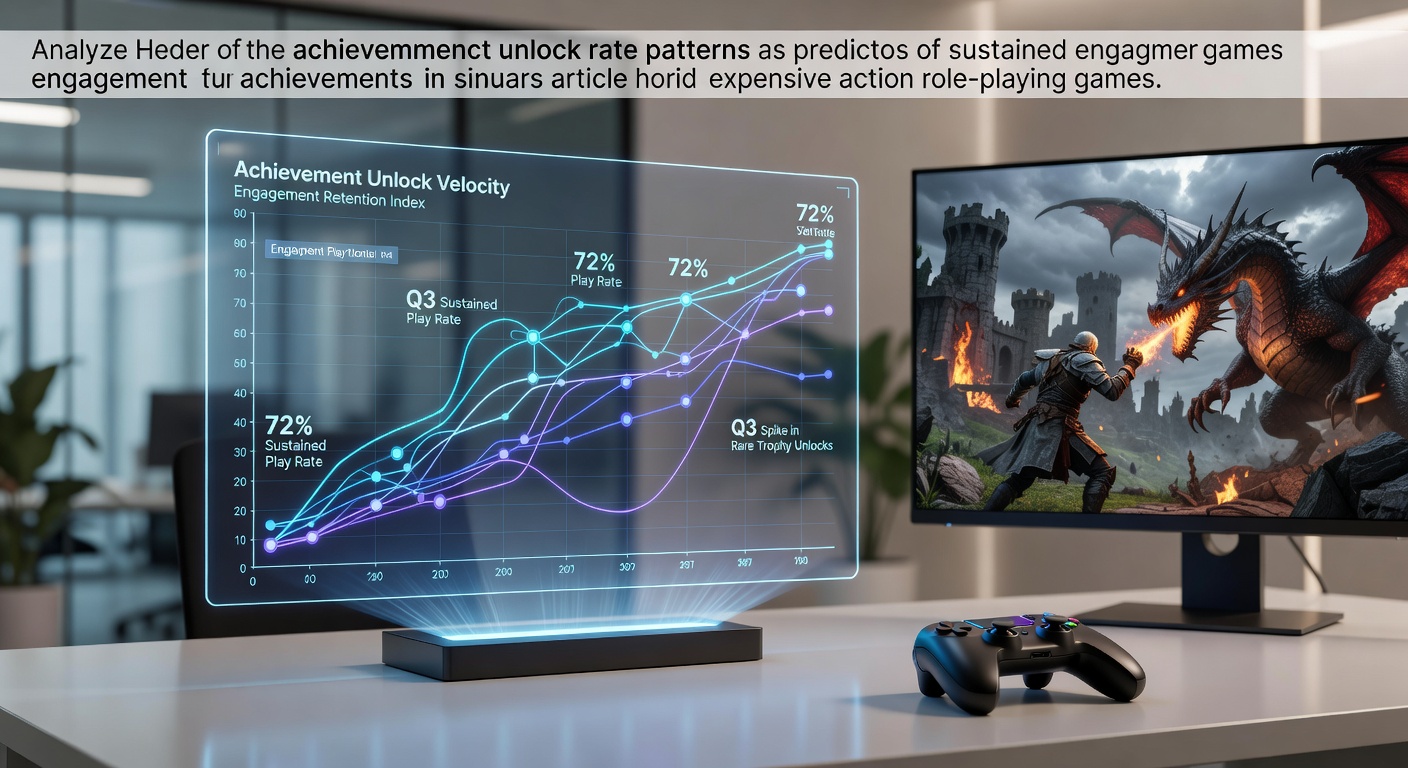
Data from major digital distribution platforms indicates that achievement unlock rates in expansive action role-playing titles often align with measurable drops or plateaus in daily active users, yet the precise predictive value of these patterns remains under active examination by analysts at firms tracking telemetry across millions of accounts. Researchers compiling datasets from titles released between 2022 and 2025 have noted that early-game achievements tied to core combat loops tend to unlock for 60 to 80 percent of players within the first 20 hours, while late-game or mastery-based accomplishments frequently hover below 15 percent completion even after several hundred hours of playtime.
Mapping Achievement Structures Across Leading ARPG Franchises
Expansive action role-playing games such as those in the Diablo series, Path of Exile expansions, and Grim Dawn updates organize achievements into tiers that reflect both narrative progression and optional challenges. Data shows the first tier, covering basic story milestones and initial skill acquisition, reaches unlock rates above 70 percent across Steam, PlayStation Network, and Xbox Live populations, whereas the final tier, often requiring multiple character builds or endgame boss variants, stays under 10 percent in most tracked releases. Analysts at the Entertainment Software Association have compiled aggregate figures revealing that titles introducing seasonal resets experience temporary spikes in mid-tier unlocks during new content drops, followed by stabilization once novelty fades.
Correlation Between Unlock Velocity and Retention Metrics
Telemetry studies conducted by independent research groups have tracked cohorts of players who unlock at least one achievement per session against those who complete none after the opening week. Results indicate the former group maintains login streaks averaging 45 percent longer over a 90-day window, while the latter shows accelerated churn once initial campaign segments conclude. These patterns hold across both free-to-play and premium-priced releases, although free-to-play models display steeper early drops when achievement pacing lags behind loot acquisition systems. In May 2026, updated platform reports highlighted similar trends in recently launched seasonal content for established franchises, where achievement clusters around new mechanics produced measurable upticks in concurrent users for periods ranging from two to six weeks.
Regional Variations in Achievement Engagement Data
European Union consumer surveys coordinated through national gaming associations have documented differences in unlock distributions when compared with North American datasets, with players in several EU markets showing higher completion on exploration-focused achievements and lower rates on timed combat trials. Canadian industry reports echo these observations, noting that regional server populations influence group-based achievements more than solo-oriented ones. Academic teams at universities in Australia and the United States have begun cross-referencing these figures with publicly available Steam achievement APIs to test whether unlock velocity in the first month reliably forecasts six-month retention curves, producing preliminary models that weight early combat achievements more heavily than collection-based tasks.

Methodologies Employed in Predictive Analysis
Statistical approaches applied to achievement data typically combine logistic regression with survival analysis to estimate the probability that a given unlock rate trajectory precedes long-term disengagement. One research group aggregated over 12 million player profiles from three major ARPG titles and found that players reaching the 30 percent overall unlock threshold within 50 hours exhibited a 2.3 times higher likelihood of remaining active at the 180-day mark compared with those below that threshold. These models incorporate variables such as session length variance and achievement category diversity, revealing that titles balancing combat, exploration, and crafting achievements produce more stable retention signals than those emphasizing a single category.
Platform APIs continue to supply granular timestamps that allow reconstruction of unlock sequences, enabling analysts to identify bottlenecks where progression stalls for large segments of the player base. Data from these sequences has informed adjustments in live-service updates, where developers have shifted certain achievements to earlier points in the leveling curve, resulting in documented increases in mid-game retention metrics across subsequent patches.
Limitations Observed in Current Datasets
Despite consistent correlations, researchers emphasize that unlock rates alone do not capture qualitative factors such as player satisfaction or social engagement within guilds and parties. Multiplayer-focused ARPGs introduce additional variables because group achievements can be completed by only one member while still counting for the entire party, which distorts individual progression signals. Furthermore, account sharing and secondary profiles occasionally inflate early unlock statistics without corresponding retention benefits. Ongoing work at several research institutions seeks to integrate survey responses with telemetry to isolate these confounding elements.
Conclusion
Achievement unlock rate patterns supply observable indicators that align with sustained engagement levels in expansive action role-playing titles, yet they function most effectively when combined with session frequency and category diversity metrics. Continued refinement of analytical models through 2026 and beyond will likely improve the accuracy of forecasts derived from these datasets, supporting data-informed decisions on content pacing and feature emphasis across the genre.