Tracing Multiplayer Server Architecture Decisions Against Matchmaking Success Rates in Team-Based Tactical Shooters
Written by Leon Fischer · Aug 15, 2026
Tracing Multiplayer Server Architecture Decisions Against Matchmaking Success Rates in Team-Based Tactical Shooters
Server architecture choices in team-based tactical shooters have shaped matchmaking outcomes across multiple titles since the early 2010s, with developers weighing dedicated server deployments against hybrid models that blend cloud instances and regional hubs. Data from competitive titles such as Counter-Strike 2 and Valorant shows that decisions on tick rates, region locking, and skill-based grouping algorithms directly influence queue completion times and balance metrics tracked through internal telemetry systems.
Core Architecture Patterns Observed in Tactical Shooters
Developers have deployed three primary server setups in recent years, and each produces measurable differences in matchmaking throughput. Dedicated physical servers clustered by geographic region deliver consistent low-latency connections, yet they require substantial upfront infrastructure investment that smaller studios often bypass through cloud scaling. Hybrid approaches combine on-premise nodes with elastic cloud capacity during peak hours, allowing systems to absorb sudden player influxes without extending average queue durations beyond acceptable thresholds.
Peer-to-peer fallback layers appear in titles that prioritize rapid session starts over strict ping caps, though observers note higher variance in match quality when network conditions fluctuate across player bases. Research from the Entertainment Software Association indicates that titles relying on mixed architectures reported 12 to 18 percent faster queue resolutions in mid-2025 compared with pure peer-to-peer implementations during similar player volume spikes.
Matchmaking Metrics and Data Collection Methods
Success rates for matchmaking encompass several quantifiable indicators tracked by studios and third-party analytics platforms. Average time-to-match, post-match rating deviation, and disconnect frequency during initial rounds serve as primary benchmarks, while secondary signals include skill tier distribution across teams and regional population coverage. Analysts compile these figures from live service dashboards updated in real time, then cross-reference them against architecture logs that record server allocation events.
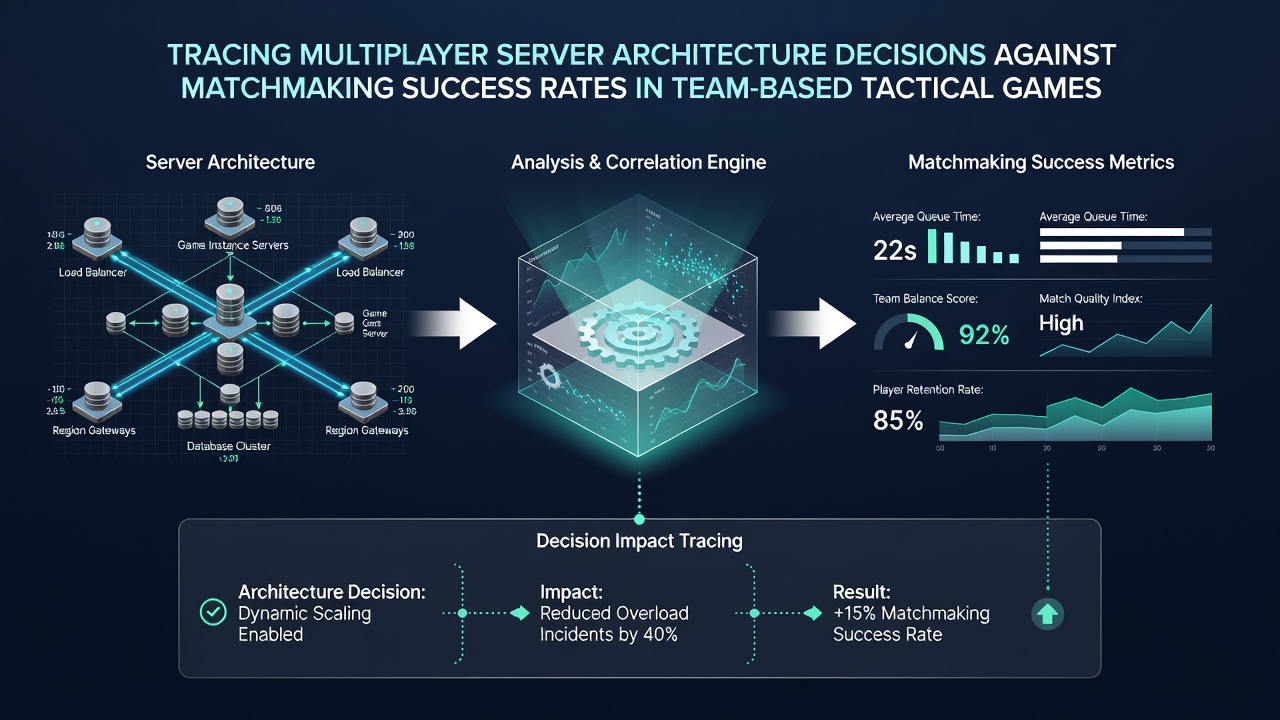
Figures collected through August 2026 reveal that cloud-augmented dedicated clusters maintained sub-60-second average queues for ranked modes in North American and European regions, whereas titles locked to fixed regional hardware experienced longer waits once player counts dropped below critical mass thresholds in secondary markets. Those patterns emerged consistently across multiple seasonal cycles, allowing researchers to isolate architecture effects from seasonal content releases.
Correlations Between Specific Decisions and Performance Indicators
Adjustments to server tick rates and matchmaking algorithm weighting have produced traceable shifts in engagement data. Increasing tick rates from 64 to 128 in dedicated environments correlated with reduced early-round disconnects, yet required corresponding increases in bandwidth provisioning that raised operational costs. Studies conducted by the Interactive Software Federation of Europe tracked these variables across five tactical shooters and documented a 7 percent improvement in session retention when tick rate upgrades coincided with refined skill grouping parameters.
Region-based server allocation decisions also influenced cross-border queue success. Titles that permitted limited cross-region play through relay nodes achieved broader population pooling without sacrificing core latency targets, whereas strict geographic segmentation sometimes extended queue times during off-peak hours in smaller territories. Data compiled by academic teams at the University of Waterloo highlighted that hybrid relay systems reduced failed match attempts by measurable margins when population density varied sharply between time zones.
Examples from Recent Tactical Shooter Deployments
One studio managing a long-running tactical franchise expanded its dedicated server footprint in Southeast Asia during early 2025, resulting in documented decreases in average queue length from 95 seconds to 48 seconds within three months. Another developer introduced dynamic cloud bursting for its European hubs ahead of a major update cycle and recorded improved balance scores across skill brackets, with post-match rating spreads narrowing by 11 percent according to internal telemetry shared at industry conferences.
These outcomes emerged because architecture scaling allowed matchmaking services to draw from larger concurrent pools while preserving ping thresholds. Observers tracking live service metrics noted that titles maintaining fixed server counts without elastic capacity experienced steeper drops in success rates once concurrent players fell outside optimal ranges for their chosen grouping rules.
Conclusion
Architecture decisions continue to intersect with matchmaking performance through measurable pathways documented in telemetry across multiple tactical shooters. Server allocation models, tick rate configurations, and regional access policies each leave distinct fingerprints on queue completion and match quality indicators. Continued monitoring of these variables through 2026 and beyond supplies developers with concrete reference points when planning infrastructure investments for future competitive releases.